
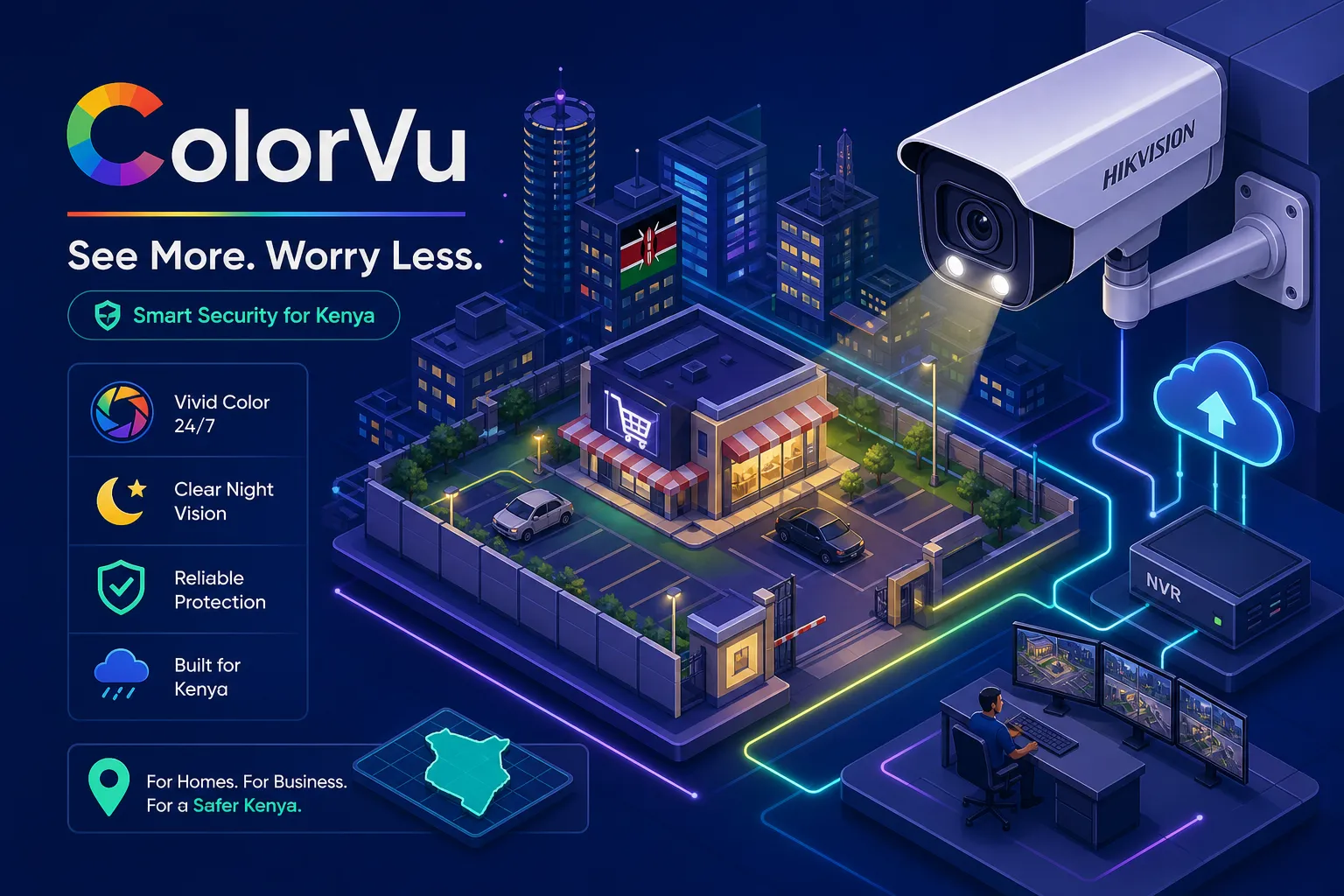
Hikvision ColorVu cameras solve one of the most persistent problems in Kenyan surveillance: many CCTV systems installed across homes and businesses still record in monochrome at night, producing grainy footage that tells you very little about a person's clothing, the colour of a vehicle, or the precise details of an incident. It is one of the questions the team at Nashnaal Electronics hears most frequently: "Why does my camera record in black and white at night, and what can I do about it?" ColorVu is the answer, a camera technology that delivers full-colour video even in near-darkness, without requiring stadium-style floodlighting.
This guide covers everything you need to choose the right ColorVu model for your site in Kenya. You will understand how the technology actually works, how it compares to standard IR cameras, which models are available locally and at what prices, the specifications that genuinely matter, and how to match a camera to your specific location, whether that is a gated home in Kiambu or a warehouse on Mombasa Road.
What Hikvision ColorVu is and how it keeps colour on at night
The F1.0 aperture and high-sensitivity sensor
ColorVu is not a software filter or a marketing label. It is a hardware design built around two physical components: a super-large F1.0 aperture lens and a high-sensitivity CMOS sensor. Many standard cameras use smaller apertures, F2.0 or narrower, and rely on invisible infrared LEDs to illuminate a scene in monochrome. ColorVu takes a different approach entirely.
An F1.0 aperture lets in significantly more light than an F2.0 lens. The difference is not marginal: the larger aperture allows the sensor to capture ambient colour that would be invisible to a conventional camera in low-light conditions. Most ColorVu models supplement this with a warm white LED that casts a subtle, visible glow rather than the invisible infrared used on traditional cameras, keeping the scene in full colour even at near-zero lux levels.
Hikvision ColorVu 3.0 and the role of AI image processing
ColorVu 3.0 keeps the same F1.0 and large-sensor formula as earlier generations but adds HikAI-ISP: an AI-based image processor that handles noise reduction, 3D LUT colour correction, motion blur reduction, and AI-driven WDR. The practical effect is cleaner, brighter, and more accurate night footage compared to earlier ColorVu versions, which relied more heavily on the optical components alone.
The full-colour image is produced inside the camera itself, not by the recorder. This matters for system integrators: ColorVu cameras are compatible with a wide range of Hikvision NVRs and DVRs, and a firmware update on the recorder can unlock AI classification features without affecting the camera's colour capability in any way.
How ColorVu footage compares to traditional IR cameras at night
What full-colour video changes in a real incident
The practical value of 24/7 colour surveillance becomes clearest during an incident review. A suspect in a red jacket at a supermarket entrance is immediately identifiable in ColorVu footage. On an IR camera, that same person appears as a grey figure among grey surroundings, no clothing colour, no scene context, and no vehicle colour if they arrived by car. The difference between identifying a suspect and losing the lead entirely often comes down to whether the camera recorded in colour.
Colour footage also adds meaningful context around licence plate identification. While plate readability still depends on distance, motion, and glare, the surrounding vehicle colour and scene context that ColorVu provides give investigators far more to work with than a monochrome IR image can offer.
The honest trade-offs worth knowing before you decide
ColorVu cameras emit a visible warm glow from the supplemental white LED, which means they are less discreet than IR cameras for covert monitoring purposes. In environments with strong existing ambient light, well-lit car parks or brightly lit indoor spaces, the difference between ColorVu and a good IR camera narrows noticeably. ColorVu is not the right choice for every location, and acknowledging that upfront is more useful to you than a blanket recommendation.
Where ColorVu clearly wins is in any outdoor or semi-outdoor location in Kenya where ambient light is inconsistent, incident review is a priority, and identifying clothing colours and vehicle types matters. For truly covert monitoring, gate detection systems, for instance, a standard IR camera remains the more appropriate choice, since it produces no visible glow that could alert a subject.
Hikvision ColorVu models available in Kenya: form factors and price ranges
Bullet, turret, and dome: which form factor fits where
Three main form factors are available in Kenya's market, each suited to different installation contexts. Bullet cameras are long-range and directional, making them well suited to perimeter walls, car parks, and building exteriors where the camera's visible profile also acts as a deterrent. Turret cameras are compact, vandal-resistant, and offer flexible angle adjustment, making them ideal for corners, corridors, and retail interiors. Dome cameras offer a wide-angle, ceiling-mount profile that suits offices, shop floors, and reception areas where a discreet overhead view is needed.
On pricing, entry-level Turbo HD ColorVu bullet models start from around KSh 4,000 for 2MP options, while 4MP IP ColorVu bullet and turret models range from approximately KSh 9,000 to KSh 21,000 depending on resolution and specification. ColorVu dome models such as the DS-2CD2147G2-LSU are priced in the KSh 15,950 to KSh 18,000 range at current Kenyan retail. Prices vary by resolution, whether the camera is IP or Turbo HD, and whether it carries added features such as AcuSense human and vehicle detection. Prices shown are indicative and should be confirmed with your supplier, as they may exclude VAT and are subject to change.
IP ColorVu vs Turbo HD ColorVu: matching the camera to your existing setup
IP ColorVu cameras run over Cat5 or Cat6 Ethernet cable and are powered by PoE, connecting directly to a PoE NVR or PoE switch. Turbo HD ColorVu cameras run over coaxial cable and require a DVR. The choice between them is largely determined by your existing infrastructure rather than by the colour performance, which is equivalent across both types.
If you are building a new system from scratch, IP over PoE is the cleaner and more scalable choice. If you have existing coaxial cabling in your building, Turbo HD ColorVu lets you upgrade to full-colour footage without rewiring, a significant cost saving on larger sites. One important note for PoC-capable Turbo HD models: if the camera supports Power over Coax, the DVR must also support PoC; otherwise a separate 12V power feed is required at each camera point.
Key specifications to evaluate before making a purchase
Resolution, minimum lux, and WDR: what the numbers mean
ColorVu models span 2MP, 4MP, 5MP, and 8MP resolutions. For most home and small business installations in Kenya, 4MP offers the best balance between image detail and storage cost. A 4MP ColorVu camera recording continuously in H.265+ will use roughly 900 GB per camera over 30 days, with night scenes consuming slightly more bitrate than daytime footage due to the additional scene information captured in colour. As a conservative planning allowance, budget approximately 20 to 25 percent more storage than you would for a comparable IR camera, the actual increase in typical deployments may be lower, but this margin accounts for variable scene complexity.
Minimum illumination figures for current ColorVu models are extremely low. Most 4MP and above models achieve 0.0005 lux at F1.0 with AGC on, with some 3K and LPR variants reaching 0.0003 lux. In practice, this means usable colour footage in conditions where no visible light source is apparent to the human eye.
WDR performance is equally important for Kenyan outdoor environments. Older 2MP ColorVu models typically offer 120dB WDR, while most current 4MP and above models provide 130dB true WDR, capable of handling the high-contrast outdoor conditions common to Kenyan sites throughout daylight and into evening hours.
Recorder compatibility and cabling requirements
For IP ColorVu cameras, Hikvision's AcuSense NVRs and I-series NVRs offer the most reliable compatibility and full AI feature support. Specific AcuSense VPRO models such as the DS-7608NXI-I2/8P and DS-7616NXI-I2/16P are recommended pairings for ColorVu 3.0 cameras, offering 8 and 16 PoE ports respectively. Older K-series NVRs may function with some ColorVu models on updated firmware, but support is less consistent and AI classification features are not fully guaranteed.
For Turbo HD ColorVu cameras, a compatible Hikvision DVR with the correct channel resolution and signal type is required. In both cases, updating the recorder to the latest firmware before commissioning is among the most reliably effective steps for ensuring compatibility and enabling AI features such as human and vehicle classification. Remote viewing via the Hik-Connect mobile app works with both IP and Turbo HD ColorVu systems, provided the recorder is connected to the internet and Hik-Connect platform access is enabled in the device settings.
Matching the right Hikvision ColorVu camera to your specific site
Home and residential installations in Kenya
For a typical Nairobi residential installation covering a gate entrance, perimeter wall, and parking area, a 4MP IP ColorVu bullet or turret paired with an AcuSense PoE NVR covers the most common requirements: full-colour identification at access points, human and vehicle classification for smart alerts, and remote mobile access via Hik-Connect. The white LED illumination range on most 4MP ColorVu turret and bullet models reaches 30 to 40 metres (verify the exact figure against the datasheet for your chosen model), which is sufficient for the majority of residential perimeter and driveway applications.
For landlords managing a compound or gated community, a combination of ColorVu turrets at common area entrances with a PoE NVR bundle provides a practical and scalable setup. A free site survey is available with selected NVR bundle purchases at Nashnaal Electronics (confirm availability with the team), which ensures the correct cameras are placed at the right angles before a single item is ordered.
Small businesses and commercial premises
For retail shops, pharmacies, and supermarkets, the priority is identifying faces and clothing at the point of entry and at till areas. Here, 4MP ColorVu turrets or domes on a PoE NVR offer the best combination of colour detail, vandal resistance via IK10-rated dome models, and interior coverage. The 130dB WDR on current 4MP models handles the bright-outside, dim-inside contrast that is common at shop entrances across Nairobi.
For outdoor commercial perimeters such as warehouses, yards, and parking areas, 4MP ColorVu bullet cameras with IP67 weatherproofing and 130dB WDR handle the high-contrast outdoor conditions common to Kenyan commercial perimeters throughout daylight and into evening hours. A site survey before purchase changes camera placement decisions significantly and prevents the common mistake of buying the wrong model for the wrong location.
Where to buy genuine Hikvision ColorVu cameras in Kenya
Why the source of your ColorVu camera matters more than the price
At Nashnaal Electronics, the team regularly encounters customers who have purchased non-genuine Hikvision units from informal traders, units that fail to deliver the colour performance the brand is known for. These products are sold at attractive prices but lack valid warranty coverage, often deliver inferior night-time colour performance due to substandard sensors and lenses, and have no local support path when they fail. The white LED and optical components in a genuine ColorVu camera are produced to Hikvision's manufacturing specification; a grey-market unit may look similar on the shelf but perform very differently in the field.
Genuine Hikvision ColorVu cameras purchased through authorised channels come with manufacturer warranty coverage, verified firmware, and full access to Hikvision's remote support and software ecosystem. A lower upfront price on a grey-market unit almost always results in a higher total cost once replacement hardware, re-installation labour, and lost incident footage are factored in.
What Nashnaal Electronics offers beyond the hardware
Nashnaal Electronics (NE) sources Hikvision products through official supply channels and operates as a specialist distributor of genuine Hikvision surveillance equipment in Nairobi. The team's focus on authentic stock means customers receive cameras running verified firmware from the moment of purchase, which matters in a market where confirming product authenticity without a trusted supply relationship is genuinely difficult for the average buyer.
NE's model covers supply and professional on-site installation; after-sales support is handled by the same local team. The camera is set up correctly from the start, the NVR is configured for full compatibility, and the customer has a direct contact when a question arises, rather than being left to troubleshoot alone post-purchase. A free site survey is available with selected NVR bundle purchases (confirm availability with the team), ensuring the right Hikvision ColorVu models are specified for actual site conditions before any hardware is ordered. Contact the NE team directly for a quote or installation enquiry.
Choosing the right Hikvision ColorVu camera starts with understanding your site
Hikvision ColorVu delivers genuine 24/7 full-colour footage through hardware engineering, not software trickery. The right model depends on your site type, your existing cabling infrastructure, your resolution requirements, and your budget. The range is wide, and the specifications can feel overwhelming when you are comparing model numbers across resolution classes, form factors, and recorder compatibility requirements.
Starting with a site survey from a knowledgeable local team makes practical sense before committing to hardware. Those looking to install or upgrade to Hikvision ColorVu cameras in Kenya can reach the team at Nashnaal Electronics for a product recommendation matched to their site, a professional installation quote, and an honest assessment of what their specific location actually needs.
Frequently asked questions about Hikvision ColorVu
Does Hikvision ColorVu work without any light at all?
ColorVu cameras combine a large F1.0 aperture with a supplemental white LED, so they can produce full-colour footage even when there is no visible ambient light. The LED illuminates the scene rather than relying solely on ambient light. That said, useful range is still limited by the power of the LED, most 4MP models cover 30 to 40 metres; verify the exact figure against the datasheet for your chosen model.
What is the difference between ColorVu and AcuSense?
ColorVu refers to the colour-at-night hardware technology: the F1.0 lens, high-sensitivity sensor, and supplemental white LED. AcuSense is Hikvision's AI-based classification engine that distinguishes humans from vehicles to reduce false alarms. Many current Hikvision ColorVu cameras include both, but they are separate capabilities, a camera can be ColorVu-equipped without AcuSense, and compatibility depends on the recorder as well as the camera.
Can I add Hikvision ColorVu cameras to my existing DVR?
Turbo HD ColorVu cameras will work with compatible Hikvision DVRs over existing coaxial cabling, provided the DVR supports the correct signal type and resolution. Firmware compatibility is the most common issue: update the DVR to the latest available firmware before commissioning. IP ColorVu cameras require a PoE NVR or PoE switch and cannot connect to a coaxial DVR.
Are Hikvision ColorVu cameras suitable for indoor use?
Yes. ColorVu turret and dome models are widely used in indoor retail, office, and corridor environments. In well-lit indoor spaces the white LED may not activate at all during the day, and the camera behaves like a standard colour unit. The colour advantage becomes most relevant during evening or overnight hours when interior lighting is reduced.
How do I verify that a Hikvision ColorVu camera is genuine?
Hikvision provides a product verification tool on their official website where you can check the serial number of any unit. Genuine cameras also carry a QR code on the packaging that links to the verification page. Purchasing from an established supplier with a traceable supply chain remains the most reliable way to ensure authenticity.